Austin has developed one of the most respected Japanese restaurant scenes in the American South, anchored by Uchi — a restaurant that has won national recognition and helped define what modern Japanese cuisine looks like outside of major coastal cities. But beyond Uchi, Austin has a growing collection of serious sushi bars, izakayas, and ramen shops that serve Japan's food culture in all its depth and diversity.
This guide covers the best sushi and Japanese restaurants in Austin, TX — with specific neighborhood locations, what to order, price ranges, and the reservation strategies you need to actually get in.
Best Sushi & Japanese Restaurants in Austin, TX
1. Uchi — South Lamar (801 S Lamar Blvd)
Uchi is Austin's most celebrated restaurant, full stop. Chef Tyson Cole's flagship Japanese restaurant on South Lamar has won a James Beard Award for Best Chef: Southwest, been named one of America's 50 Best Restaurants multiple times, and fundamentally changed how Austin (and much of the South) thinks about Japanese cuisine.
What to order: The menu is built around hot and cold "tastings" — small plates designed for sharing. Must-orders include: Hama Chili (yellowtail, jalapeño, citrus, crispy shallot), Machi Cure (cured yellowtail with yuzu kosho and orange), and the Uchi Salad (mixed greens with toasted coconut, pepitas, and miso-citrus dressing). The seasonal Chef's Tasting Menu ($95–$120 per person) is the ideal way to experience the full range of the kitchen.
Price range: À la carte tastings $12–$45 each. Tasting menu $95–$120. Cocktails and sake $14–$20. Budget $100–$180 per person for a comprehensive experience.
Reservation: One of Austin's hardest tables to get on weekends. Reservations open 30 days in advance on Resy at midnight — set an alarm. Check daily for cancellations.
Hours: Daily 5 PM – 10 PM.
2. Uchiko — North Austin (4200 N Lamar Blvd)
Uchiko is Uchi's sister restaurant on North Lamar — a farm-to-table influenced Japanese restaurant that leans even further into local, seasonal Texas ingredients than its sibling. The approach is described as "Uchi meets Central Texas farm stand" — and the result is an equally excellent but distinctly different experience.
What to order: The Bo Ssäm (Korean-Japanese preparation of slow-cooked pork shoulder, served tableside with accompaniments) is Uchiko's most theatrical dish and ideal for groups of 4–6. The Jidori Chicken (airline breast with schmaltz potato and pickled mustard greens) is one of the most satisfying dishes in Austin. Sushi omakase is available and excellent.
Price range: Essentially identical to Uchi — tastings $12–$42, tasting menus available.
Reservation: Slightly easier to get than Uchi — still book 2–3 weeks ahead on Resy for weekends.
Hours: Daily 5 PM – 10 PM.
3. Kyoten Omakase — East Austin (3714 N I-35 Frontage Rd)
Kyoten is Austin's most serious traditional omakase experience — a counter-only restaurant where chef Otto Phan (who trained at Uchi before launching Kyoten) serves a 20-course Edomae-style sushi omakase in an intimate 12-seat setting. The fish is sourced from Japan through the legendary Tsukiji outer market network.
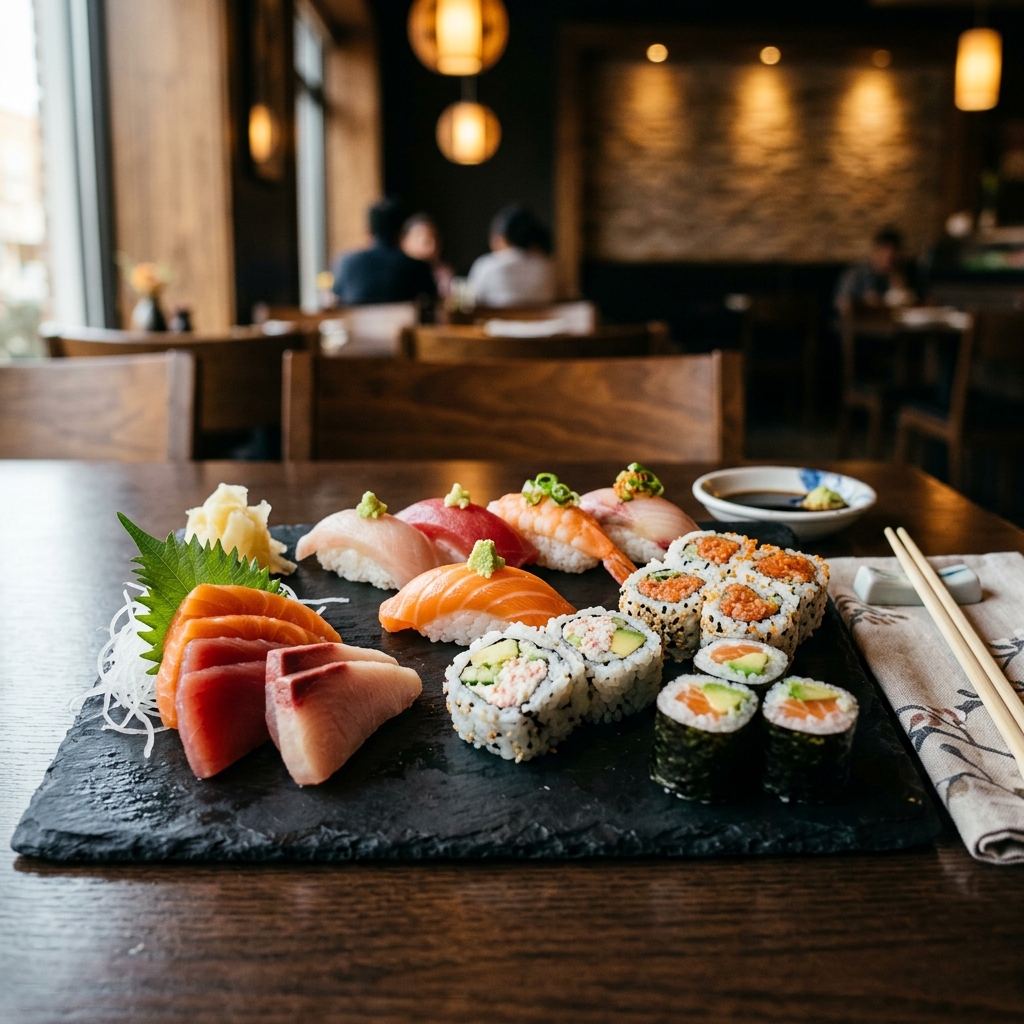
What to order: There is no menu — you sit at the counter and chef Otto Phan feeds you 20 courses over 2 hours. Expect exceptional nigiri (fatty tuna, sea urchin, Japanese snapper, spot prawn) prepared with Edomae technique (aged, seasoned, sauced at the counter). This is the most technically precise sushi in Austin.
Price range: The omakase is $150–$200 per person (drinks not included). The drink pairing — sake, Japanese whisky, or wine — adds $60–$80.
Reservation: Kyoten is notoriously difficult to book — reservations open on the first of each month for the following month and sell out within minutes. Join their email list and follow their Instagram for reservation announcements.
Hours: Tuesday–Saturday, two seatings per evening (typically 6 PM and 8:30 PM).
4. Ramen Tatsu-Ya — Multiple Austin Locations (South Lamar: 1234 S Lamar Blvd)
Ramen Tatsu-Ya is not a sushi restaurant — it is the best ramen restaurant in Austin, and possibly the best in Texas. Founded by brothers Tatsu Aikawa and Takuya Matsumoto, Ramen Tatsu-Ya serves tonkotsu-style ramen with a depth and precision that earns it comparison to the best ramen shops in Japan.
What to order: The Tonkotsu ORIG — the original house ramen with 60-hour pork bone broth, chashu pork belly, soft-boiled egg, nori, and green onion — is the definitive order. The HiGAWARI (off-menu daily special ramen) is served in limited quantities and features seasonal variations. The Karaage chicken and Gyoza are the essential appetizers.
Price range: Ramen bowls $14–$18. Add-ons (extra chashu, egg, noodles) $2–$5.
Hours: Daily 11 AM – 10 PM. Weekend waits can reach 45–60 minutes during peak lunch and dinner. Arrive at opening or after 8 PM.
5. Fukumoto — East Austin (1715 E 6th St)
Fukumoto is Austin's best izakaya — the casual Japanese pub dining concept that revolves around small sharing plates, Japanese draft beer and highballs, and a convivial atmosphere. Located on East 6th Street in a beautifully designed space, Fukumoto draws a devoted local crowd that returns weekly.
What to order: The Agedashi Tofu (crispy-outside, silky-inside tofu in dashi broth) is a benchmark version. The Yakitori Chicken (skewers cooked over binchotan charcoal) is outstanding. The Sashimi plate is fresh and carefully sourced. The Whisky Highball program — featuring Japanese and Taiwanese whiskies — is exceptional and pairs naturally with the food.
Price range: Small plates $8–$18. Sashimi $16–$28. Very reasonable for the quality.
Hours: Tuesday–Sunday 5 PM – 10 PM (kitchen), bar until midnight.
Austin Japanese Food Insider Tip: The best way to experience Austin's Japanese restaurant scene efficiently is to treat Uchi and Uchiko as annual or semi-annual special occasions (book early, budget for it), and discover Fukumoto and Ramen Tatsu-Ya as reliable weekly-rotation restaurants where you can explore the menu deeply over multiple visits. Kyoten is the once-a-year (or once-in-Austin-life) experience that you plan specifically and save for.
Understanding Austin's Japanese Food Scene
Austin's Japanese restaurant culture has developed in a specific way that differs from cities with large Japanese-American communities (like Los Angeles or the Bay Area):
Chef-driven, not community-driven: Unlike LA or NYC where Japanese restaurants serve a Japanese and Japanese-American customer base, Austin's Japanese restaurants were built by chefs (Tyson Cole, Otto Phan) who trained in Japanese technique and are cooking primarily for a non-Japanese audience who learned to appreciate the cuisine through the restaurants themselves.
Heavy influence of Uchi: Nearly every serious Japanese restaurant in Austin has some lineage to Uchi — either through chef alumni, stylistic influence, or direct competition. The Uchi effect has raised the overall quality bar enormously.
Texas ingredients: Austin's Japanese restaurants integrate Texas ingredients in ways you won't find elsewhere — jalapeños in the Hama Chili, Texas peaches in seasonal desserts, Texas wagyu in nigiri at Kyoten.
Tips for Japanese Dining in Austin
- Uchi vs. Uchiko: If you can only go once, Uchi on South Lamar is the canonical experience. If you've been to Uchi before, Uchiko is different enough to justify a return visit
- Kyoten is worth the effort — the reservation process is difficult, but there is no more technically accomplished sushi in Texas. Plan 6–8 weeks ahead
- Ramen Tatsu-Ya lines: Arrive at 11 AM opening or after 8 PM to minimize your wait. The ramen is worth a 30-minute wait; a 60-minute wait requires strategic planning
- Sake education at Uchi/Uchiko: Both restaurants have dedicated sake programs with staff who can guide you through selections by style (junmai, ginjo, daiginjo) and flavor profile. Tell them your price range and flavor preferences
Final Thoughts
Austin's Japanese restaurant scene is one of the great success stories of the city's food culture. What Uchi started two decades ago — proving that exceptional Japanese cuisine could thrive in Central Texas — has produced a generation of talented chefs, serious izakayas, technically precise omakase counters, and outstanding ramen shops. The scene is still growing, and Austin's Japanese food culture will only deepen as more talent concentrates in the city.